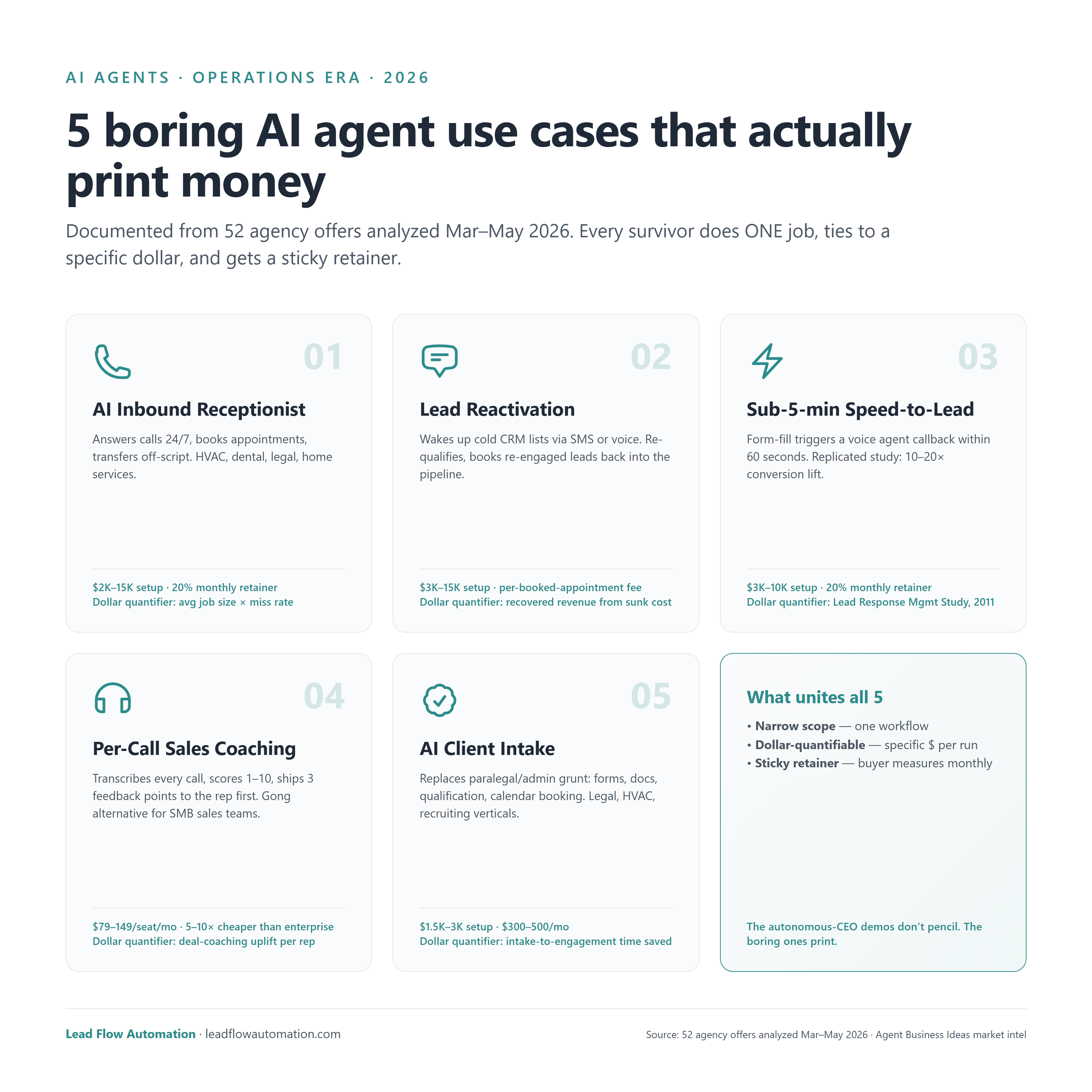
TL;DR. Most AI agent demos showing autonomous CEOs and do-everything assistants do not survive 30 days in production at a small business. The five use cases that actually generate measurable dollars — and stick as monthly retainers — share three traits: narrow scope (one workflow), dollar-quantifiable outcome (not "time saved"), and a sticky measurement the buyer checks each month. The five: (1) AI inbound receptionist, (2) cold-list lead reactivation, (3) sub-5-minute speed-to-lead callback, (4) per-call sales coaching for SMB sales teams, and (5) AI client intake for service firms. Each ties to a specific dollar — missed-call cost, recovered cold lead, conversion-lift math, replaced paralegal hours. Industry pricing conventions documented from 52 agency offers analyzed March–May 2026.
The AI agent conversation in 2026 has moved past "is this possible?" to "what survives production?" Across 52 agency offers reviewed between March and May 2026, the pattern is consistent: the agents that print money are boring. The viral demos quietly die in month one. This article documents what actually works at the small-business scale, with pricing conventions, the dollar math behind each use case, and the audit questions a non-technical founder should ask any vendor before signing.
What is an AI agent for a small business?
An AI agent for a small business is a software system that uses a large language model — typically Claude, GPT, or Gemini — to autonomously execute one specific operational workflow on the business's behalf. Unlike a chatbot (which only converses) or a generic AI tool (which assists a human at a single task), an agent runs unattended, makes decisions within defined constraints, and produces a measurable outcome the operator can audit each month.
The workflows that survive in production are narrow and dollar-quantifiable. The ones marketed as "AI employee that does everything" almost universally fail within 30 days because the surface area of decisions exceeds what current models can handle reliably without human review.
The 5 use cases that actually generate dollars
Each does exactly one job, ties to a measurable dollar, and survives the typical 30-day SMB attention span.
1. AI inbound receptionist
The agent answers inbound calls 24/7, books appointments into a calendar, and transfers callers to a human only when the conversation goes off-script. Most common in HVAC, plumbing, dental, legal, and home-services verticals.
Pricing convention: $2,000–$15,000 setup, plus a 20% monthly retainer (typically $200–$1,500/month).
Why it sticks: Every missed call has a measurable dollar value — average job size multiplied by miss rate. A roofer missing 8 calls a week at a $4,500 average ticket is leaving $1.4M/year on the table. The agent's monthly fee is a rounding error against that recovery.
Common stack: Retell AI or Vapi for voice; n8n or Make for the calendar integration; Twilio for the phone number.
2. Lead reactivation for cold CRM lists
The client already paid the acquisition cost on leads that went cold. The agent wakes them up via SMS or voice (compliance permitting), re-qualifies them, and books re-engaged prospects back into the sales calendar.
Pricing convention: $3,000–$15,000 setup, plus a per-booked-appointment performance fee ($30–$150 per booking).
Why it sticks: Recovered revenue from a sunk cost — the cleanest agency pitch on the market. The CFO doesn't have to approve new ad spend; the agent monetizes leads that were already paid for.
Compliance note: TCPA in the US and GDPR in the EU both cap cold outreach. Only reactivate leads who opted in within 18 months, segment by jurisdiction, and keep a documented consent log. Skipping this step turns a profitable agent into a fine that eats a quarter.
3. Sub-5-minute speed-to-lead callback
A web form fills, and within 60 seconds an AI voice agent calls the lead back to qualify and book a meeting.
Pricing convention: $3,000–$10,000 setup plus 20% monthly retainer.
Why it sticks: The Lead Response Management Study (Oldroyd et al., InsideSales / Harvard Business Review, 2011) — and its subsequent replications — found that contacting a lead within five minutes versus an hour later produces approximately 10–20× the conversion rate. That math is defensible in a sales meeting and survives the buyer's CFO review. Few SMB tools have such a clean, citable ROI argument.
4. Per-call sales coaching for SMB sales teams
After every sales call, the agent transcribes the recording, scores the rep on a 1–10 scale, and emails three specific feedback points to the rep before the manager sees it.
Pricing convention: $79–$149 per seat per month — roughly 5–10× cheaper than enterprise sales-coaching alternatives.
Why it sticks: Gong, the enterprise standard, costs approximately $1,200+ per seat per year and is priced for 50-rep teams. SMBs with 3–10 sales reps need the same outcome — call insight, coaching, deal hygiene — at SMB pricing. Once reps see their own private dashboard, they don't want it taken away.
Critical design choice: Send the feedback to the rep first, the manager second. Frame the agent as coaching, not surveillance — otherwise reps quietly stop sending calls through the system, and the contract dies in week three.
5. AI client intake for service firms
Used in legal, HVAC, recruiting, and other professional-service verticals where intake is the bottleneck. The agent replaces paralegal or admin grunt work: collects intake forms, requests documents, qualifies leads against firm criteria, and books the qualified ones into the partner's calendar.
Pricing convention: $1,500–$3,000 setup plus $300–$500/month.
Why it sticks: Intake-to-engagement time drops from days (paralegal queue) to minutes (agent-driven). Law firms in particular measure this metric monthly because every day of intake delay correlates with retainer drop-off.
What unites the use cases that work
Three traits cut across all five:
- Narrow scope. Each agent does exactly one job in one workflow. Agents that try to be "your AI employee" fail because the decision surface exceeds what current models can handle reliably.
- Dollar-quantifiable outcome. Every successful agent run ties to a specific dollar — missed-call cost, booked-appointment fee, recovered cold lead, replaced paralegal hour. The dead ones promised "time saved" or "better customer experience," which buyers can't measure on a P&L.
- Sticky retainer. The buyer checks the result monthly because they see the dollar move. Once the AI receptionist is booking $40K/month of new appointments, no operator pulls the plug.
How to evaluate an AI agent vendor before buying
Four questions a non-technical founder should ask any AI agent vendor before signing:
- What's the ONE workflow this replaces? If the answer is multiple, walk away.
- What dollar does each successful agent run produce or save? If the vendor can't quantify it in 60 seconds, the agent will fail your CFO review at month two.
- Where's the human approval gate? Full autonomy fails on edge cases. The survivors all have a clearly defined hand-off to a human.
- Who gets paged when the agent misbehaves? Without monitoring, you'll find out about a $3,000 voice-minute bill on the credit card statement.
A vendor who hand-waves any of the four is not deployment-ready.
Frequently asked questions
What's the average cost of an AI agent for a small business?
Across 52 documented agency offers (March–May 2026), median pricing is a $3,000 setup fee and $500–$1,500/month retainer. Voice-based agents (receptionist, speed-to-lead) skew higher because of per-minute voice infrastructure costs. SMS-only or text-based agents (intake, lead scoring) skew lower.
Are AI agents worth it for small businesses under $1M revenue?
Yes, when the use case is dollar-quantifiable. A sub-$1M HVAC business missing 5 calls a week at a $1,200 average ticket loses approximately $312K/year — a $500/month receptionist agent recovers a large fraction of that and pays for itself in the first booked job each month.
What's the difference between an AI agent and an AI chatbot?
A chatbot converses. An agent acts — it books, transfers, sends, qualifies, escalates. The distinction matters because chatbots produce conversation transcripts (hard to monetize), while agents produce booked appointments, qualified leads, and scored calls (directly monetizable).
How long does an AI agent deployment take?
Production-ready deployments for the five use cases above typically take 2–6 weeks. Setup includes vendor integrations (calendar, CRM, voice infrastructure), prompt engineering, escalation rules, and a 1–2 week monitored shadow period before full handoff.
Can a non-technical small business owner run an AI agent without a developer?
Yes. The underlying stack (Retell, n8n, Airtable, Twilio) requires technical setup, but the running system requires no in-house developer. The owner approves edge cases via a Slack or Telegram bot; the agency handles maintenance, monitoring, and prompt updates.
What are some examples of AI agents already used by small businesses?
The five most common in 2026: an inbound voice receptionist for a plumbing or HVAC business, a cold-list reactivation SMS agent for a marketing agency, a sub-5-minute speed-to-lead callback agent for a real-estate or roofing company, a per-call sales coaching agent for a 5-rep insurance team, and an intake agent for a personal-injury law firm. All five share the narrow-scope, dollar-quantifiable, sticky-retainer pattern.
Which AI agents work best for small business marketing?
For SMB marketing specifically, the highest-ROI agents are lead reactivation (re-engaging cold CRM lists) and speed-to-lead callback (catching new form-fills within 5 minutes). Both directly tie to pipeline dollars and don't require the marketing team to learn a new tool — the agent operates in the background and writes results back to the existing CRM.
Sources and methodology
- Lead Response Management Study, Oldroyd et al., InsideSales / Harvard Business Review, 2011 — primary source for the 5-minute speed-to-lead conversion math.
- Gong public pricing — reference for enterprise sales-coaching cost benchmarks.
- TCPA (US Telephone Consumer Protection Act) and GDPR (EU General Data Protection Regulation) — cited as the compliance constraints on cold-list reactivation.
- 52 agency offers analyzed from public Upwork postings, March–May 2026 — internal market-intelligence database (Lead Flow Automation Agent Business Ideas pool).